Study: Kuwaiti Economy Under External Pressures Beyond Control
A study of Kuwait’s controllable and uncontrollable fiscal variables, warning that oil dependence cannot sustain the economy without policy change.
1. Introduction
Years pass, and the question remains as to whether the Kuwaiti economy is capable of pulling itself “by itself” out of its economic crisis — a crisis that has been, and still is, the result of continuing to live within the cave of near-total dependence on oil export rent. We therefore turned to the numbers in search of an answer, hoping that predictions based on the data of previous years might draw a clearer picture, so that we may see with greater certainty and understand whether the mechanisms followed over the past four years are sufficient to redirect the economy toward a brighter future.
The dilemma is not the book deficits that are filled, one way or another, through vague returns from sovereign fund investments, only to become an argument repeated by those who claim that Kuwait faces no real deficit. The true dilemma that must be resolved is that the Kuwaiti economy and its reserves depend on equations whose variables are affected by factors capable of increasing or decreasing those equations at an exponential rate. Although a number of variables can be controlled, others cannot. This report therefore comes to clarify those variables and the means of hedging against their negative movement on the Kuwaiti economy in the coming years, aiming to identify the correct direction toward a sustainable economy.
2. Variables Outside the Scope of Control
Despite the importance of “variables within the scope of control,” we must first examine variables related to the factors of time, the direction of the economy, and the progress of research across all countries of the world. In this report, we call them “variables outside the scope of control.” The reason for focusing on these variables is that their coefficients cannot be controlled. The primary objective is to compare the rate of change in the “variables outside the scope of control” within the revenue equation with the rate of change in their counterparts within the expenditure equation.
2−1. Revenues
Annual Revenues = Oil Revenues + Non-Oil Revenues
When examining the revenue equation, the “price of a barrel of oil” may be taken as the coefficient of the “oil revenues” variable, under the assumption that Kuwait’s oil production volume is nearly fixed. At the same time, the “price of a barrel of oil” depends entirely on the factor of “oil scarcity” through a positive relationship: the greater the scarcity of oil, the higher its price. It is worth noting that such scarcity cannot be controlled domestically. It depends entirely on research developments across all countries of the world, regardless of whether domestic economic policies take this scarcity into consideration. Accordingly, the oil revenues variable is classified as a “variable outside the scope of control.”
On the other hand, “government performance” may be taken as the coefficient of the “non-oil revenues” variable. The more state institutions improve their performance in creating a business environment that attracts local and foreign investors, the higher non-oil revenues become, especially alongside modern tax laws. Accordingly, the non-oil revenues variable is classified as a “variable within the scope of control.”
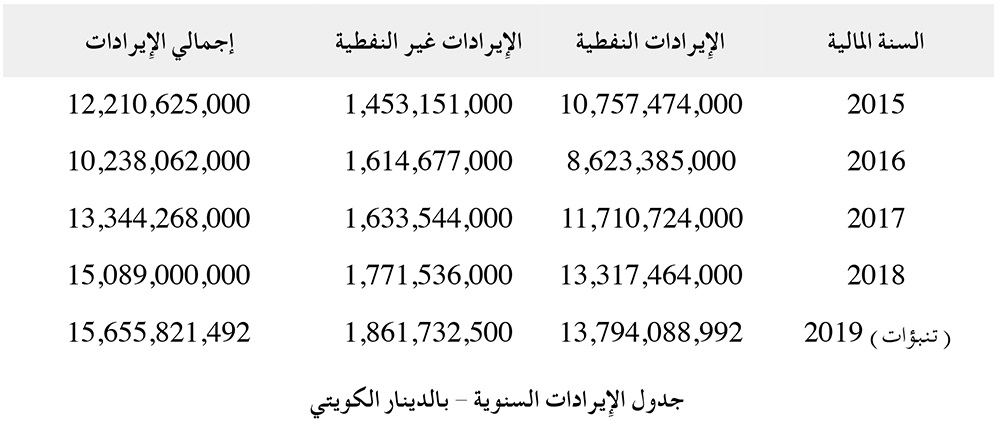
During the period from the beginning of fiscal year 2015 to the end of fiscal year 2018, non-oil revenues constituted 12.9% of total revenues: 11.9% in 2015, 15.7% in 2016, 12.2% in 2017, and finally 11.7% in 2018. Oil revenues, which are a “variable outside the scope of control,” therefore constituted 87.1% of total revenues. Using linear regression analysis to read these observations and other data, oil revenues are projected to constitute 88.1% of total revenues by the end of 2019, with statistical error rates of 7% for forecasting the value of non-oil revenues and 45% for forecasting the value of total revenues.
After taking these statistical notes into account, it becomes clear that “oil revenues” rise at a rate of 5.2%, equivalent to 607 million Kuwaiti dinars annually. However, there is a ceiling limiting this increase, namely the fixed daily oil production volume of the State of Kuwait as set by OPEC. This ceiling is therefore exposed to the influence of the oil price, which is itself tied to the scarcity factor described above.
2−2. Expenditures
Annual Expenditures = Fixed Expenditures + Variable Capital Expenditures + Variable Consumer Expenditures
The expenditure equation contains three variables, beginning with “fixed expenditures,” whether capital or consumer in nature. Some concepts in this economic equation differ from their accounting counterparts in the commercial field. Fixed expenditures are those expenses that can be directly controlled through government performance and spending policies, such as expenditure rationalization policies through which government spending on secondary projects is reduced. Accordingly, “fixed expenditures” are classified as a “variable within the scope of control.” As for “variable capital expenditures,” and without entering into their details, although they cannot be classified as a “variable within the scope of control,” neither can they be classified as a “variable outside the scope of control.” Rather, they fluctuate between these two classifications according to government strategies and working mechanisms.
Finally come “variable consumer expenditures,” which include the salaries of state employees and grants provided to cover the budgets of affiliated and independent government entities. There is no doubt that such grants consist, to a very high degree, of the salaries of the employees who operate those entities. Accordingly, a positive relationship emerges between “variable consumer expenditures” and the total number of citizens. The Constitution guarantees employment for citizens; and even when the private sector hires them, the state treasury supports their salaries through the Manpower Restructuring Program, known as national labor support. Since the annual increase in the number of citizens lies beyond government control — unless regulations are introduced to limit new births, or natural disasters occur, Allah forbid — “variable consumer expenditures” are classified as a “variable outside the scope of control.”
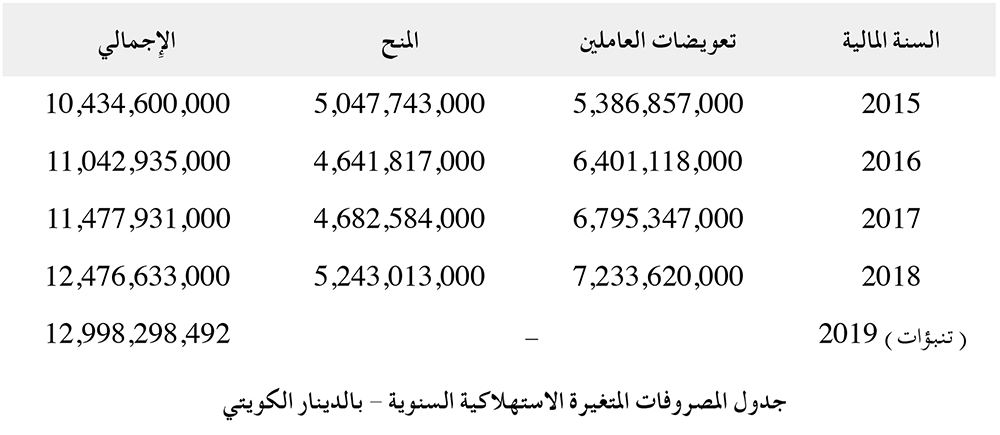
During the period from the beginning of fiscal year 2015 to the end of fiscal year 2018, variable consumer expenditures — including employee compensation and grants — were estimated at an average of 11.35 billion Kuwaiti dinars annually, according to the observations shown in the table of annual variable consumer expenditures. Using linear regression analysis to read these observations and other data, variable consumer expenditures are estimated at 12.99 billion Kuwaiti dinars, with a statistical error rate of 3% for the forecast itself.
When these statistical observations are considered, it becomes clear that “variable consumer expenditures” rise at a rate of 4.3% annually, equivalent to 512 million Kuwaiti dinars per year. It is worth noting that this increase is unlimited; in other words, it has no ceiling.
3. Variables Within the Scope of Control
3−1. Revenues
When examining “non-oil revenues” as a “variable within the scope of control” during the period from the beginning of fiscal year 2015 to the end of fiscal year 2018, they are estimated at an average of 1.6 billion Kuwaiti dinars annually, according to the observations shown in the annual revenues table. Using linear regression analysis to read these observations and other data, non-oil revenues are estimated at 1.86 billion Kuwaiti dinars, with a statistical error rate of 7% for the forecast itself. Accordingly, “non-oil revenues” rise at a rate of 4.9% annually, equivalent to 81 million Kuwaiti dinars per year.
3−2. Expenditures
As for “fixed expenditures,” if we examine the period from the beginning of fiscal year 2015 to the end of fiscal year 2018, it becomes clear that the Amiri Diwan topped the list of entities best performing in expenditure rationalization, as its working mechanisms led to a reduction in fixed expenditures by 28%, equivalent to 122 million Kuwaiti dinars annually. The Ministry of Commerce and Industry ranked second, as its spending rationalization mechanisms reduced fixed expenditures by 12%, equivalent to 41 million Kuwaiti dinars annually. The Ministry of Oil came third, with mechanisms that reduced fixed expenditures by 10.47%, equivalent to 26 million Kuwaiti dinars annually.
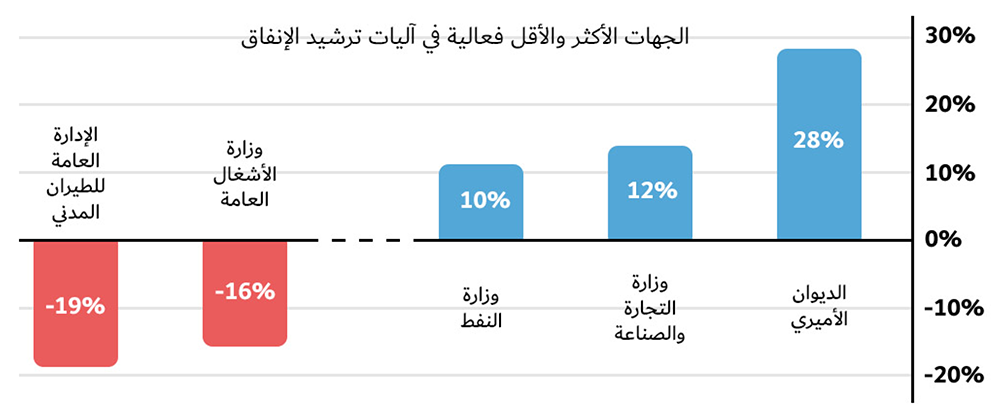
As for the entities that ranked last in expenditure rationalization during the same period, the Directorate General of Civil Aviation came in last place, with its expenditures rising by 19.1%, equivalent to 22 million Kuwaiti dinars annually. The second-to-last place went to the Ministry of Public Works, whose expenditures increased by 16.1%, equivalent to 152 million Kuwaiti dinars annually.
4. The Real Deficit
What we mean here is not the book deficit in the state budget, nor the actual deficit we witness whenever the returns on sovereign fund investments fail to cover the state’s deficit in that budget. What we seek to explain today is the deficit we suffer from as a result of insufficient awareness of the weight and dynamics of those variables lying outside the scope of control, together with their exponential factors.
The current rate of increase in oil revenues — which are projected to constitute 88.1% of total revenues in 2019 — may be higher than the current rate of increase in variable consumer expenditures, which are projected to constitute 59% of total expenditures in 2019. The reason is that the global economy has emerged from a period in which the price of a barrel of oil was at its lowest levels. However, in a very near phase, the balances will shift. The rate of change in total oil revenues will approach zero, while consumer expenditures will continue their sustained rise.
At that point, we will inevitably have to look more openly and realistically at the performance of returns on sovereign fund investments. Indeed, we should study them using the same methodology employed in this report: by distinguishing whether their variables fall within or outside the scope of control, and by examining whether the rate of increase in those returns is capable of keeping pace with the rate of increase in variable consumer expenditures. This is something that logic cannot explain, nor can a rational mind accept.
5. Recommendation
In conclusion, after presenting the analyses and figures above, we return to answer the question with which this report began: whether the Kuwaiti economy is capable of pulling itself “by itself” out of its economic crisis, whose consequences have continued to appear as a result of our persistence in living within the cave of near-total dependence on oil export rent. The answer is conditional — if, and only if. In the absence of new economic policies, the Kuwaiti economy will not be able to pull itself out of this crisis on its own.
Accordingly, our recommendations do not go beyond urging an increase in the weight of the “variable within the scope of control” in the revenue equation — namely, increasing the weight of “non-oil revenues.” At the same time, they urge reducing the weight of the “variable outside the scope of control” in the expenditure equation — namely, reducing the weight of “variable consumer expenditures.” There is no doubt that these two variables are closely related and are affected by common working mechanisms.
Therefore, we see no need to delve into issues of microeconomics or organizational behavior within state institutions and to present solutions for them, of which an endless list could be offered. Why focus on secondary solutions when we can clearly see the root and foundation of those solutions? What we seek to indicate here is that macroeconomic theories can be adopted and applied in a way capable of absorbing all microeconomic issues and addressing them more effectively. This can be done by taking the GDP equation into account when legislating laws and adopting the regulations of state institutions, and by examining whether those laws and regulations contribute to strengthening GDP sustainably — that is, only through stimulating exports, reducing imports, or both.
The End.
Abdullah Al-Salloum
Thoughtful messages and inquiries are always welcome. Send a message
Answers
What is the link between public spending and building future capacity?
Productive spending adds capacity or productivity, while spending that repeats obligations expands the burden without building new income. This makes time an important test that separates temporary treatment from capacity that can endure.
How does Kuwait’s fiscal variables and oil dependence affect Kuwait?
Its effect appears in how costs, incentives, and resources are managed, and in Kuwait's ability to turn decisions into sustainable value. The direct context is kuwait’s controllable and uncontrollable fiscal variables, warning that oil dependence cannot sustain the economy without policy change.
What is the link between fiscal sustainability and building future capacity?
Sustainability is not secured by revenue size alone; it depends on turning resources into renewable financial capacity while controlling recurring obligations. This makes time an important test that separates temporary treatment from capacity that can endure.
What is the link between public obligations and building future capacity?
A state’s financial strength weakens as fixed obligations expand, because the room for reform narrows even when revenues appear large. This makes time an important test that separates temporary treatment from capacity that can endure.
Related articles
The “Triple Economy”: Building Glory Brick by Brick
11 Sep. 2025
11 Sep. 2025
Publishing outlets