Absence of Rentierism Does Not Mean Sustainability
An analysis of rentier and sustainable economies, arguing that self-reliance and export diversity are the true path beyond oil dependence.
In a study by Hossein Mahdavy titled “The Patterns and Problems of Economic Development in Rentier States: The Case of Iran,” published in 1970 in the Oxford University journal, the rentier economy was defined as an economy that depends mostly or entirely on revenues from a single source of income. The characteristics of the rentier state were centered on: 1) the government’s full control over the source of income, 2) the source of income not depending on local productivity, and 3) only a small segment of the population contributing to the administration and export activities that secure this source of income.
There is no doubt that the study was, at the time, an inspiration to many economists, as it was published around a new concept. A concept that began to explain the economic changes in the region following the emergence of oil and gas. This produced robust economies despite their dependence on a single source such as oil and gas. But in an age in which minds are striving to find ways to move from a rentier economy to another economy that is even more resilient, let us suppose that the Gulf were to depend on another source of income that does not deplete a natural resource like oil and gas — such as software revenues. Let us assume that the people of the Gulf excel in studying software and applying it, becoming the first choice for any technology project around the world. Would that constitute a rentier economy? There is no doubt that this assumption contradicts the characteristics of the rentier state. The source of income here depends heavily on local productivity, a large portion of the population contributes to the administration and export activities that sustain that source of income, and the government does not control that source of income. But does being a non-rentier economy necessarily mean that it is sustainable? If we assume that the age of software ends because of the emergence of a superior technology, that would be enough to destroy the Gulf economy under our first assumption. Thus, we conclude that while we can be certain of the non-sustainability of the rentier economy, we cannot at the same time be certain of the sustainability of the non-rentier economy.
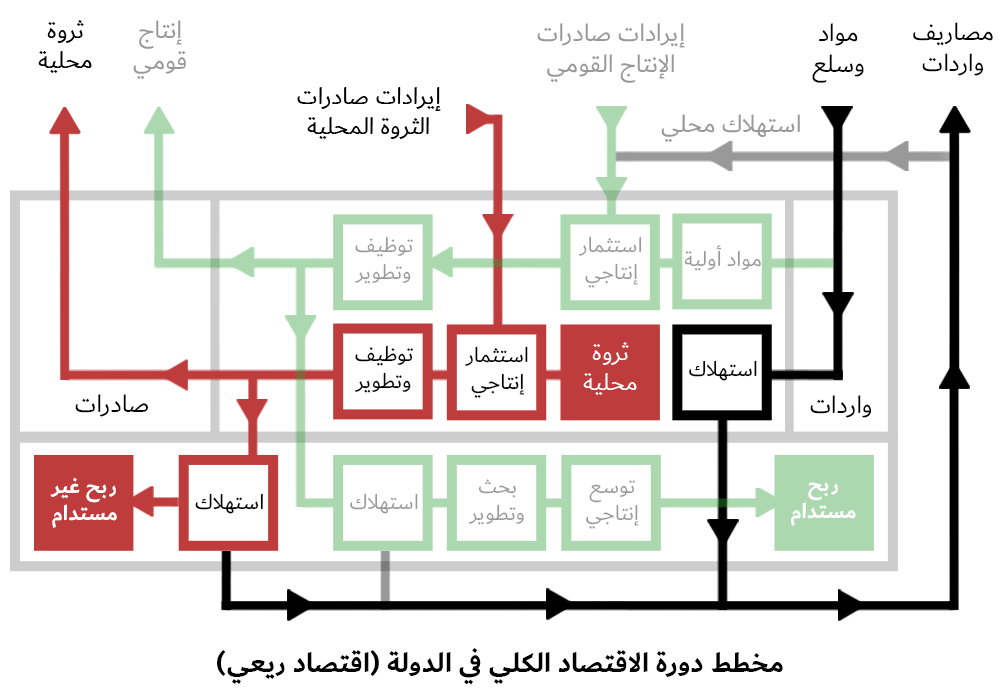
The chart above is a living example of the macroeconomic cycle in a rentier state, assuming it conforms to the characteristics mentioned in the study. The chart in red shows the total dependence of that state’s economy on revenues from exporting its local resource wealth. These revenues are invested in production, export, and employment, while part of them is consumed in other expenditures such as state institutions and authorities, leaving behind unsustainable profit. There is no doubt that this profit will stop as soon as the local resource wealth — the very reason for the economy’s rentier nature — runs out. As for the chart in green, it does not carry the same weight in influencing the state’s macroeconomy. It depends largely on the consumption generated by the red chart, which in the end rests on the export of local resource wealth. If that wealth comes to an end, it will undoubtedly affect both charts, red and green. The Gulf states are a fitting example. The private sector in its entirety, across all its branches, has been negatively affected by government spending-rationalization plans, and the reason lies in the green chart’s dependence on the red.
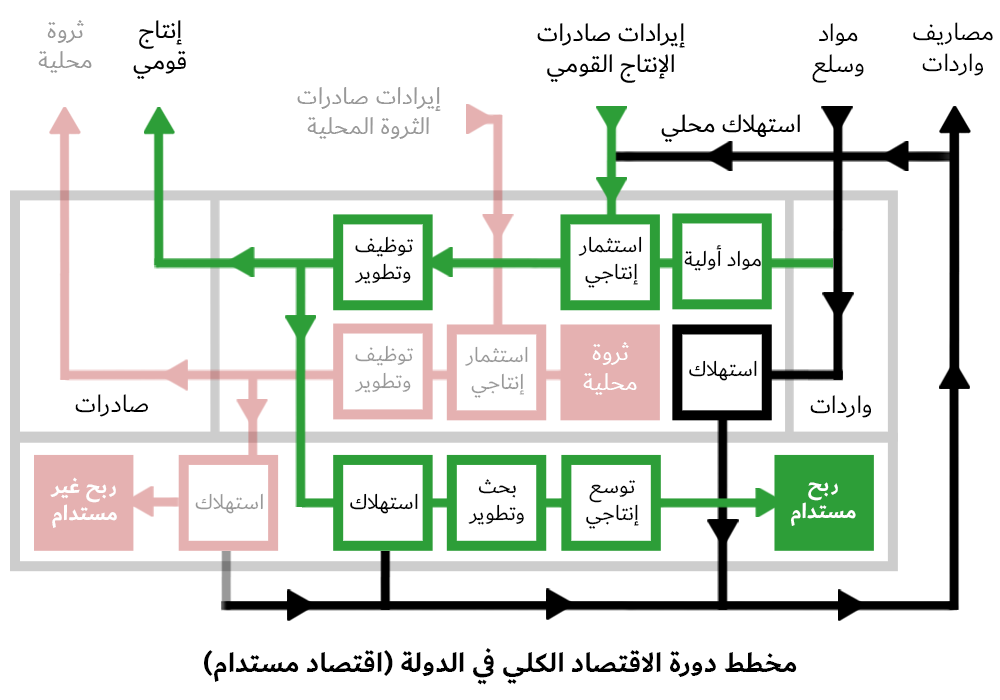
The priority in transitioning to a sustainable economy begins by focusing the revenues of local resource exports on stimulating revenues from the export of national production — in other words, by using the red chart to build a strong green chart. The first step is to eliminate customs duties if the imports are raw materials. This is followed by raising customs duties on imports for which a local substitute exists, thereby encouraging domestic consumption toward the local product instead of the foreign one, and thus reducing import expenditures. Finally, the revenues from exporting local resource wealth should be used for facilities, recommendations, and support for the private sector, with differentiation among private companies based on the size of each company’s exports. In this way, the private sector’s focus is directed straight toward the external consumer, rather than the domestic one as is now the case in the Gulf states.
Because of the rentier nature that causes the green chart to depend on the consumption of the red chart, we find many private-sector companies expanding regionally, draining local cash flow in order to build empires abroad. And because of intense competition abroad, we find them lowering their prices outside while relying on the high profit margin at home. It is as though domestic consumption spent abroad is what sustains the private sector’s expansion plans. This is wholly inconsistent with the concept of a sustainable economy.
There is no doubt that building the green chart is capable of creating diversity in the private sector — diversity that stands on its own and draws its energy from itself, whether through reprocessing raw materials extracted domestically, or through investing in itself and in the minds on which it is built, to produce what is worthy of the trust of the foreign consumer. It is that foreign consumer who creates the continuous increase in the revenues of national production. Self-reliance is what ends rentierism, and diversity is what creates sustainability.
There is no doubt that the study was, at the time, an inspiration to many economists, as it was published around a new concept. A concept that began to explain the economic changes in the region following the emergence of oil and gas. This produced robust economies despite their dependence on a single source such as oil and gas. But in an age in which minds are striving to find ways to move from a rentier economy to another economy that is even more resilient, let us suppose that the Gulf were to depend on another source of income that does not deplete a natural resource like oil and gas — such as software revenues. Let us assume that the people of the Gulf excel in studying software and applying it, becoming the first choice for any technology project around the world. Would that constitute a rentier economy? There is no doubt that this assumption contradicts the characteristics of the rentier state. The source of income here depends heavily on local productivity, a large portion of the population contributes to the administration and export activities that sustain that source of income, and the government does not control that source of income. But does being a non-rentier economy necessarily mean that it is sustainable? If we assume that the age of software ends because of the emergence of a superior technology, that would be enough to destroy the Gulf economy under our first assumption. Thus, we conclude that while we can be certain of the non-sustainability of the rentier economy, we cannot at the same time be certain of the sustainability of the non-rentier economy.
The chart above is a living example of the macroeconomic cycle in a rentier state, assuming it conforms to the characteristics mentioned in the study. The chart in red shows the total dependence of that state’s economy on revenues from exporting its local resource wealth. These revenues are invested in production, export, and employment, while part of them is consumed in other expenditures such as state institutions and authorities, leaving behind unsustainable profit. There is no doubt that this profit will stop as soon as the local resource wealth — the very reason for the economy’s rentier nature — runs out. As for the chart in green, it does not carry the same weight in influencing the state’s macroeconomy. It depends largely on the consumption generated by the red chart, which in the end rests on the export of local resource wealth. If that wealth comes to an end, it will undoubtedly affect both charts, red and green. The Gulf states are a fitting example. The private sector in its entirety, across all its branches, has been negatively affected by government spending-rationalization plans, and the reason lies in the green chart’s dependence on the red.
The priority in transitioning to a sustainable economy begins by focusing the revenues of local resource exports on stimulating revenues from the export of national production — in other words, by using the red chart to build a strong green chart. The first step is to eliminate customs duties if the imports are raw materials. This is followed by raising customs duties on imports for which a local substitute exists, thereby encouraging domestic consumption toward the local product instead of the foreign one, and thus reducing import expenditures. Finally, the revenues from exporting local resource wealth should be used for facilities, recommendations, and support for the private sector, with differentiation among private companies based on the size of each company’s exports. In this way, the private sector’s focus is directed straight toward the external consumer, rather than the domestic one as is now the case in the Gulf states.
Because of the rentier nature that causes the green chart to depend on the consumption of the red chart, we find many private-sector companies expanding regionally, draining local cash flow in order to build empires abroad. And because of intense competition abroad, we find them lowering their prices outside while relying on the high profit margin at home. It is as though domestic consumption spent abroad is what sustains the private sector’s expansion plans. This is wholly inconsistent with the concept of a sustainable economy.
There is no doubt that building the green chart is capable of creating diversity in the private sector — diversity that stands on its own and draws its energy from itself, whether through reprocessing raw materials extracted domestically, or through investing in itself and in the minds on which it is built, to produce what is worthy of the trust of the foreign consumer. It is that foreign consumer who creates the continuous increase in the revenues of national production. Self-reliance is what ends rentierism, and diversity is what creates sustainability.
Abdullah Al-Salloum
Thoughtful messages and inquiries are always welcome. Send a message
Answers
How does rentier economies and self-reliance affect the economy?
Its effect appears in how costs, incentives, and resources are managed, and in the economy's ability to turn decisions into sustainable value. The direct context is rentier and sustainable economies, arguing that self-reliance and export diversity are the true path beyond oil dependence.
What is the most important question when dealing with rentier culture?
Rentier culture links gains to the state more than to production, making reform look like a threat rather than a necessary transition. Through the angle of trust, the result appears not only in declared language, but in the policy’s ability to change incentives and outcomes.
What is the most important question when dealing with living standards and productivity?
Living standards cannot remain stable without real productivity, because welfare funded externally or by a depleting resource remains vulnerable. Through the angle of trust, the result appears not only in declared language, but in the policy’s ability to change incentives and outcomes.
What is the most important question when dealing with public debate?
Debate supports reform when it seeks evidence and results; it obstructs reform when it becomes accusation, denial, or short-term gain. Through the angle of trust, the result appears not only in declared language, but in the policy’s ability to change incentives and outcomes.
Related articles
Kuwait Sustainability: The Turning Point (2/2)
06 Feb. 2020
06 Feb. 2020
Sustainability of Harees and Actuarial Studies
12 Jun. 2017
12 Jun. 2017
No Sustainability Without Private Sector Exports
16 Nov. 2018
16 Nov. 2018
Kuwait Sustainability Series: Introduction
15 Sep. 2019
15 Sep. 2019
Publishing outlets